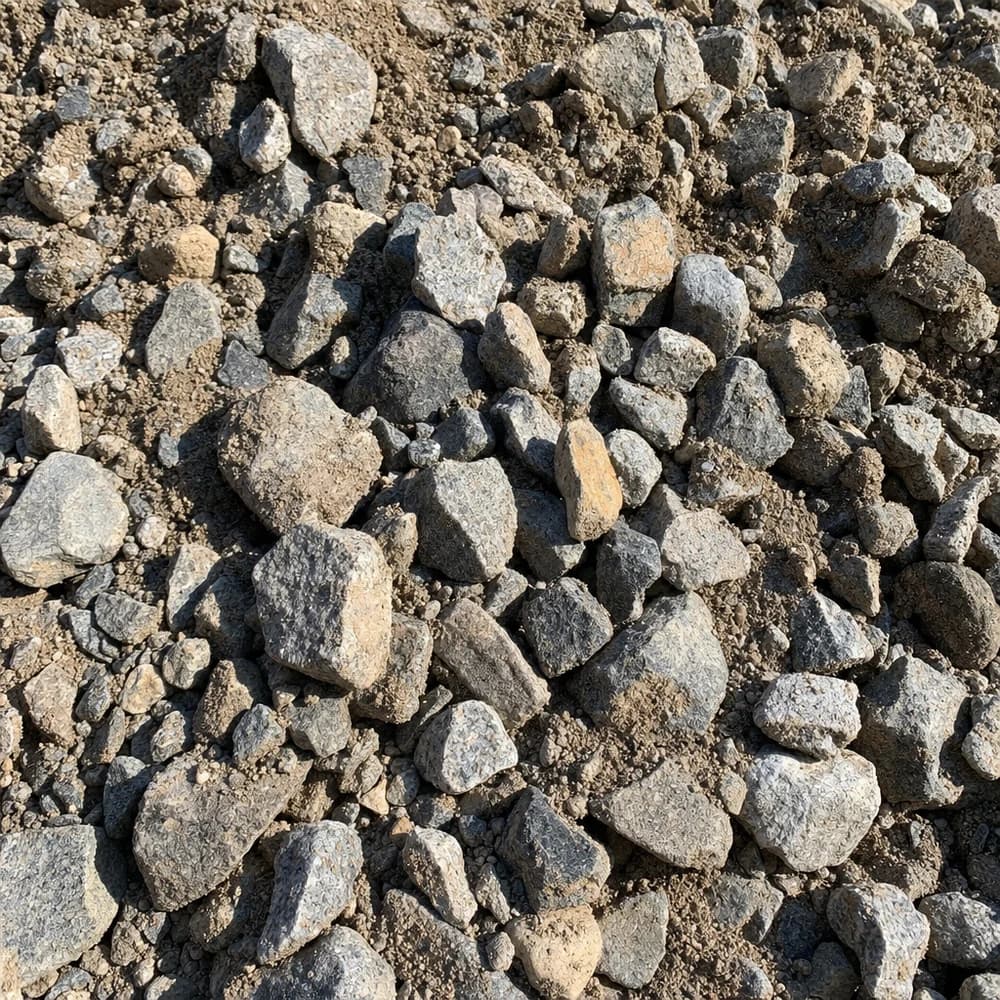
Road Base Calculator for Class 2 Lanes, Drives and Pads
Enter your project dimensions
Base work has a season, and it is not the one people plan for. The long dry stretch from late spring into autumn is when subgrade is firm enough to strip, shape and roll; once winter storms arrive, clay turns greasy under a plate compactor and a loaded truck leaves ruts in the approach. So the useful order of operations is to settle the depth and the tonnage early, while there is still dry weather to spend. This road base calculator handles the volume and the weight. What follows is about the number you put in the depth box, which is where most of the money sits.
Soft ground under a lane, and the inches it costs
Depth is chosen for what is under the base, not for the vehicle on top of it. Four inches of compacted material suits firm ground and light car traffic. Six is the working figure for a drive that takes delivery trucks and regular use. Eight to twelve belongs on soft ground, on the expansive clay found through the Coast Range valleys and many Southern California basins, and anywhere equipment will be parked.
Two local conditions push that figure up. Clay that swells in the wet season and shrinks and cracks in the dry one moves under a thin layer until it breaks up, so on clay it pays to add depth rather than width. Across parts of the Central Valley a cemented hardpan a few feet down stops water sinking any further, which leaves a drive sitting on ground that stays saturated after a storm; the answer there is depth plus a route for the water, not more surface rock. On foothill and hillside lots the opposite problem applies, because runoff arrives fast off shallow soil above and will scour the edge of a drive that has nowhere to shed to. Crown the surface two to three percent from the center line so storm water leaves rather than soaks in.
Strip organic topsoil before any stone goes down. Soil left under a base pushes mud up through the layer no matter how thick it is. On wet or rutted subgrade, woven geotextile between soil and stone keeps the two from mixing.
Mountain towns, where the building department sets the number
At elevation in the Sierra Nevada, the northern mountains and the Southern California mountain towns, freeze-thaw is a genuine design factor and snow closes the ground for part of the year. Frost depth in those towns is set by the local building department, commonly in the range of 18 to 24 inches, so check with them before settling on a thickness. Everywhere else in the state, frost is not what is driving your base depth; water is.
Center line, average width and the road base calculator
Rectangle takes a length and width in feet, which for a drive means the distance along the center line and an average width rather than the widest point. Circle takes a diameter, the quickest way to enter a turnaround or a round tank pad. Multiple areas adds up to five pieces, so a drive, the flare at the road and a parking apron can be totaled in one pass, provided they are all going in at the same depth.
Depth is entered in inches, from 0.25 to 24, and it should be the finished compacted thickness you want to end up with. Choose the material, leave the option that adds 10 percent for compaction and spillage ticked, which is how it loads, or untick it, and the result comes back as cubic yards, tons and cubic feet at once. There is no larger allowance hidden behind the button, so treat that box as the only automatic margin on the page.
Why a yard of Class 2 lands as a ton and a half
The volume half is plain: length by width gives square feet, the depth in inches divided by 12 turns that into cubic feet, and 27 cubic feet make a cubic yard. Weight is where base material separates from everything else on the site. Graded crushed rock with fines in it is published here at about 3,000 lb per cubic yard, or 1.50 tons a yard, against about 2,800 lb for clean crushed rock and driveway gravel. That is why a ton of base spreads over roughly 36 square feet at six inches compacted, and why an order that sounded like a couple of yards arrives as a serious pile.
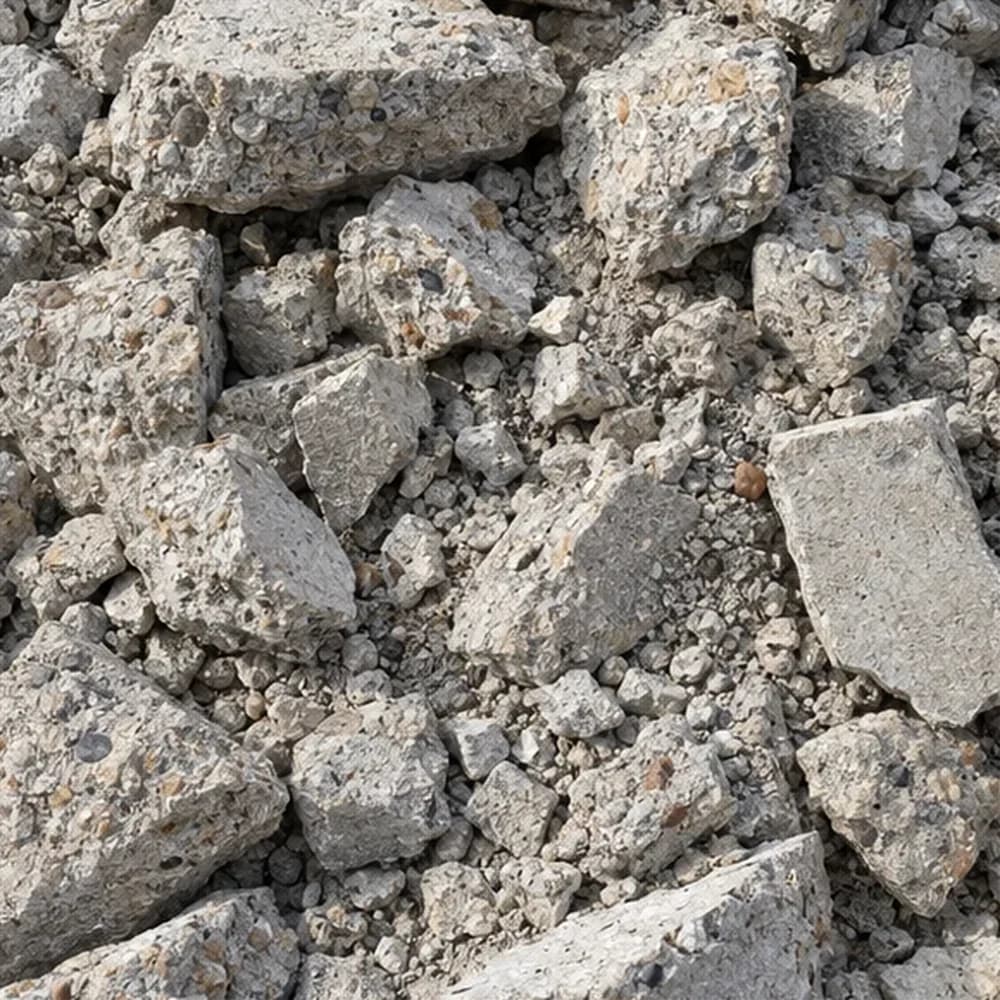
Recycled base rock, made from crushed concrete and asphalt, is calculated at the same figures. The specification that defines Class 2 also covers processed reclaimed material, which is how it is described locally, though a county or agency specification may still call for virgin rock. It is not a listing in this catalogue.
A hillside drive, an RV pad and a turnaround at the top
Three illustrations, not real orders.
A 260-foot hillside drive at six inches
Two hundred and sixty feet by an average 12 feet is 3,120 square feet. At 6 inches: 3,120 x 6 / 12 = 1,560 cubic feet, which is 1,560 / 27 = 57.8 cubic yards, or 86.7 tons at 1.50 tons a yard. Leaving the 10 percent box ticked takes it to 63.6 yards and 95.4 tons.
A 12 by 30 foot RV pad at eight inches
Three hundred and sixty square feet at 8 inches: 360 x 8 / 12 = 240 cubic feet, which is 8.9 cubic yards and 13.3 tons. Eight inches is the figure to use where the pad carries concentrated axle or corner loads, or sits on ground that softens in winter.
A 30-foot turnaround at six inches
A 30-foot circle is 706.9 square feet. At 6 inches: 706.9 x 6 / 12 = 353.4 cubic feet, which is 13.1 cubic yards and 19.6 tons.
Twenty tons is not a wheelbarrow job. Spreading and rolling at that scale wants a tractor with a box blade or a skid steer, placed in lifts of four inches or less with each layer rolled before the next goes on.
Rounding a lane order up without inflating the depth
The 10 percent option covers the material lost to spillage, to the wheelbarrow track and to the rock that disappears into a soft patch. It is not a substitute for measuring. If the margin feels thin, round the length and the average width up to the next foot, which on a long drive adds more than any percentage will, and keep the depth honest at the finished compacted figure. Entering a deeper number to create a buffer distorts the estimate for every layer above it.
Left-over base is the least wasteful surplus on a site. It patches a rut, fills a washout after the first storm of the season and levels the spot where the truck turned.
Class 2 base or crusher run for the layer you are building
Both are crushed rock with fines that lock up under a roller, and the difference is top size. Class 2 Base carries the larger top stone and is what drives, lanes, pads and the base under pavers are usually specified as in California, where Caltrans defines Class 2 aggregate base in 3/4 inch and 1-1/2 inch gradings. Crusher Run is finer, which makes it easier to screed to a tight tolerance on a small area. For anything carrying a vehicle, Class 2 is the local answer, and a tool for the finer material sits alongside this one. A surface course of 3/4" Crushed Stone or Driveway Gravel goes on top once the base is rolled. Delivery is arranged at checkout by ZIP code, and what the truck needs at the drop point is worth checking first.
Common questions
The estimate shows cubic yards and tons side by side. Which one goes on the order?
Tons. Base rock is sold by weight here, so that is the ordering figure, and the yardage is there to compare against a plan or a quote written in yards. The cubic feet reading is mostly useful for a small patch.
Do I enter the loose depth or the depth after the roller has been over it?
The compacted depth you want when the job is finished. Loose material of this kind loses a noticeable amount of height as it is rolled, which the site handles through the 10 percent option rather than by asking you to guess a loose thickness.
How do I size a round turnaround or a tree ring in a drive?
Switch to Circle and enter the diameter in feet across the widest part. A 24-foot turnaround is 452 square feet, so at 6 inches that is 226 cubic feet, 8.4 cubic yards and 12.6 tons.
Can I check the tonnage on paper before I commit to it?
Multiply length by width for square feet, multiply by the depth in inches, divide by 12 for cubic feet, then divide by 27 for cubic yards and multiply by 1.5 for tons. A 60 by 10 foot apron at 4 inches is 200 cubic feet, so 7.4 yards and 11.1 tons.
Why does the same 6 inches weigh more in base rock than in drainage stone?
Fines. Graded rock with fines packs into the spaces between the larger pieces, so a yard of it holds more material than a yard of washed stone that is all voids. About 3,000 lb a yard against about 2,800 lb, and the gap widens once it is rolled.
Related calculators
Thirty tons. Zero delivery fees.
Road base priced per ton, hauled free, at lane quantities where hauling usually costs the most.