Driveway Gravel for a Drive That Stops Migrating
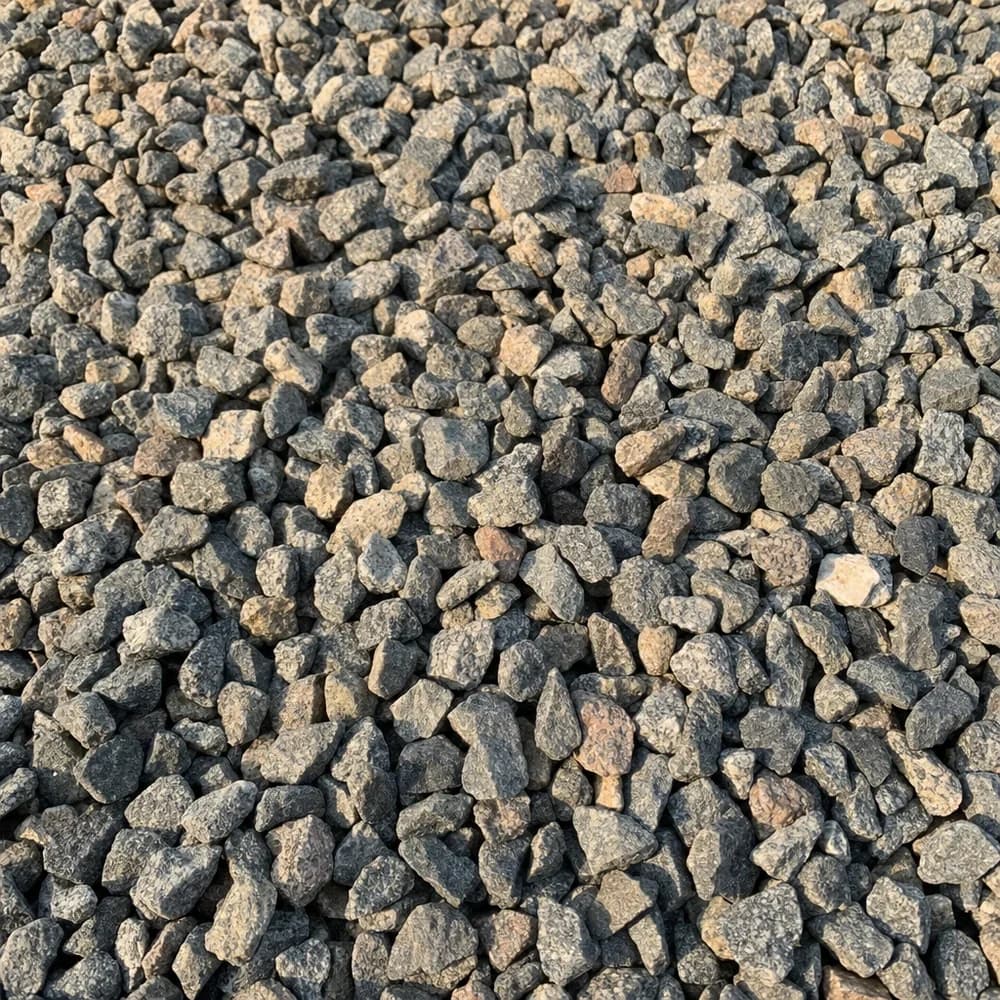
For California property entrances and parking areas, Driveway Gravel compacts into a firm driving surface that lets water move through.
- Size: 3/4 inch
- Grading: Graded mix of stone sizes
- Type: Crushed stone
From $445 for 1 ton, delivery included (larger loads cost significantly less per ton)
Free delivery included
Free delivery anywhere in California
Pick a delivery date
Weekday delivery, earliest Oct 29
“Needed driveway gravel and ordered from them. Really happy with how it turned out.”
Lisa G. · Verified Buyer
Get a Free Quote
Fill out the form and our sales team will get back to you within the hour.
Size and Grading
- Size
- 3/4 inch
- Grading
- Graded mix of stone sizes
- Type
- Crushed stone
Rounded stone on a hillside lane looks perfect in October and has largely relocated to the ditch by March. That is the mistake driveway gravel is bought to correct more often than any other. The material that fails is almost always single-sized and smooth, so it behaves like ball bearings under a tire and like a stream bed when the first atmospheric river runs down the length of the drive. The fix is a graded, angular mix that locks against itself and holds the fines that bind it.
Why does driveway gravel keep ending up in the ditch and not on the drive?
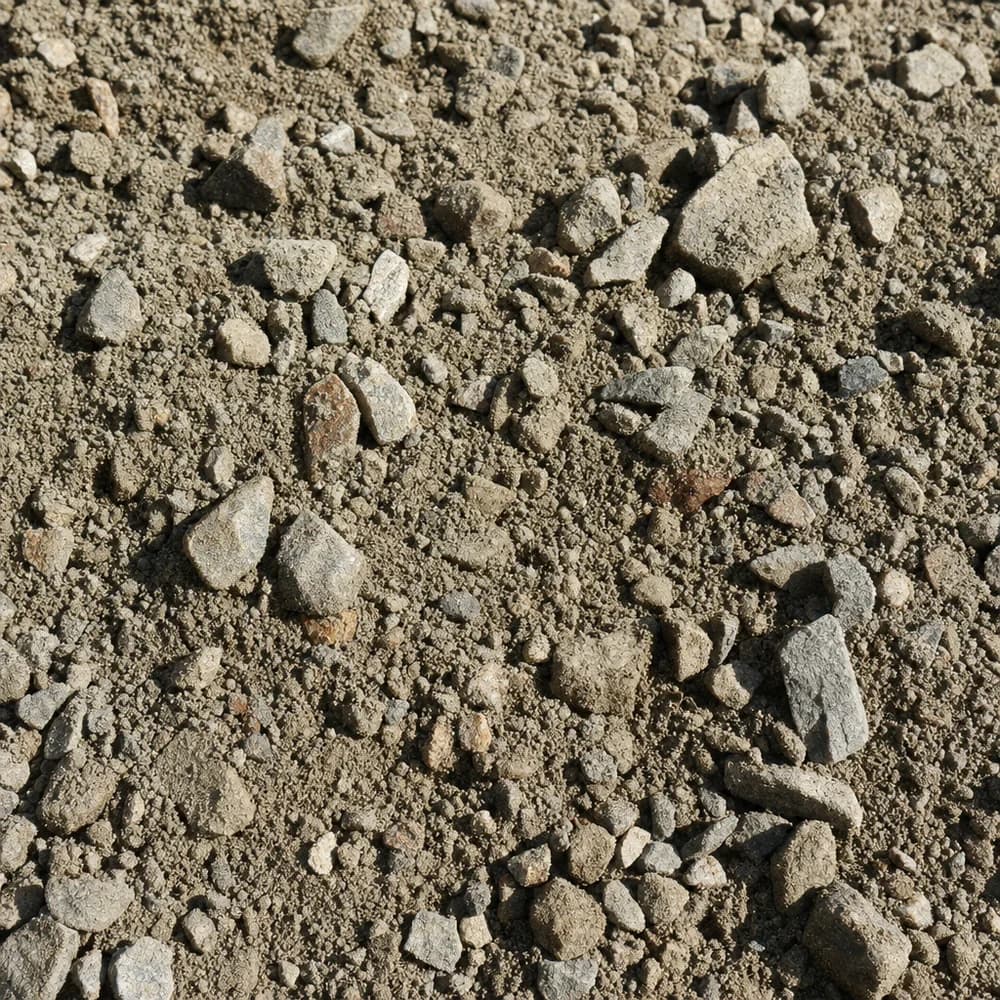
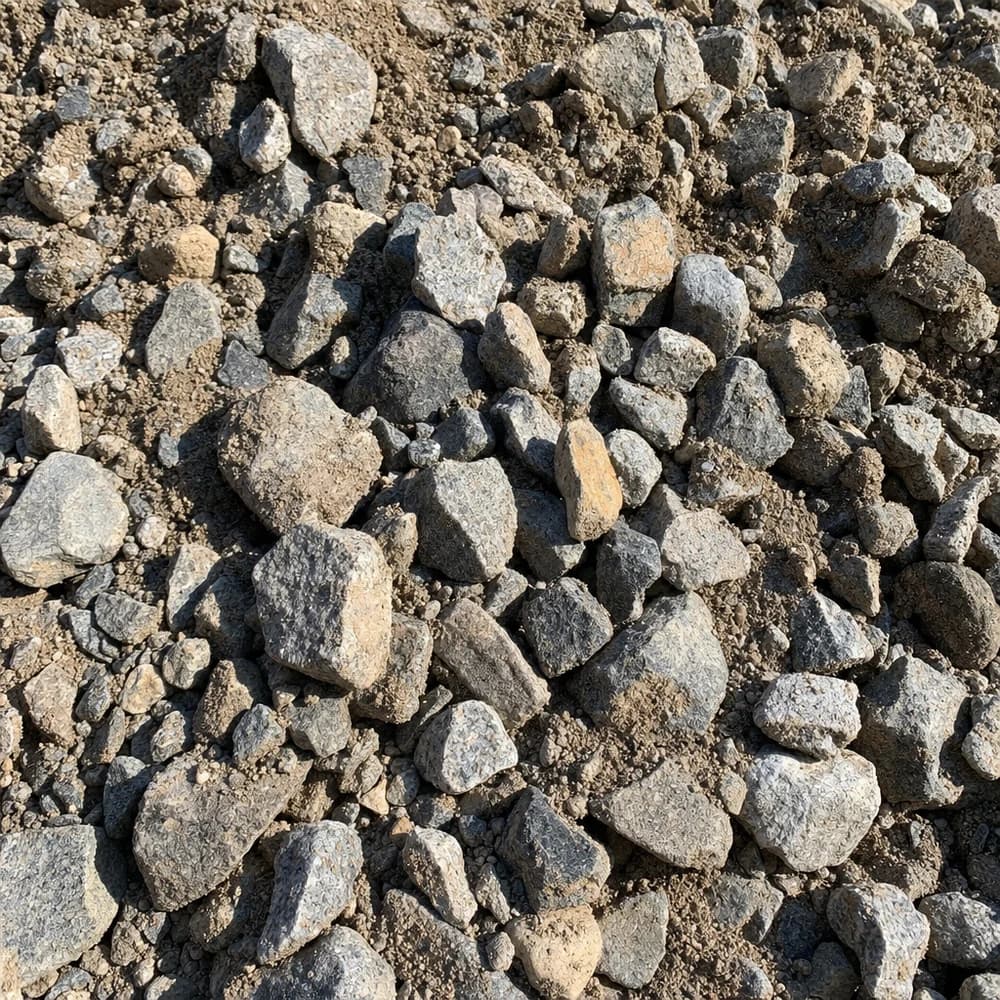
Two properties decide whether a surfacing stone stays put. The first is shape. This product is crushed, so every piece has flat faces and corners that wedge against its neighbors instead of rolling past them. The second is grading. It is a graded mix of stone sizes topping out around 3/4 inch, which means the smaller pieces and fines sit down in the gaps between the larger ones. Compact that and you get a surface that behaves as a sheet rather than as loose material.
Smooth, uniform stone has neither property. It cannot interlock and it has nothing to fill its own voids, so the first heavy vehicle spreads it sideways and the first storm carries the top of it downhill. If your current drive is doing that, the stone itself is the diagnosis.
Does it need a base under it, or can it go straight on the ground?
Straight onto native soil it will work loose, and on the shrink-swell clay common through the Coast Range valleys and the Southern California basins it will do so quickly, because the clay softens under it in the wet months and lets the stone press in. The usual build is a compacted layer of Class 2 Base shaped to a crown or a cross-slope, with the surfacing gravel placed and compacted on top of it. The base carries the load and the gravel takes the wear.
There is an exception on the foothill lots where weathered granite is already the native ground. That subgrade is coarse and drains on its own, so a well-shaped surface can sit on less section. What it still needs is somewhere for the runoff coming off the slope above to go, because any drive that becomes a channel loses its surface one storm at a time.
Would it bed a paver patio, or is that a different layer?
A paver patio, as an example, wants a compacted base and then a thin, uniform bedding course that can be screeded dead flat. A 3/4 inch graded mix cannot be screeded to that tolerance; the largest pieces hold the screed rail up and the finished pavers rock. Use the base layer for structure and bed the pavers on Mason Sand, or on a clean small stone where a permeable build is specified. This material belongs under wheels, not under a hand-set patio.
Can it line a dry creek bed or ring a fire pit?
Neither, for opposite reasons. A dry creek bed, taking one as an example, is meant to read as a watercourse and to slow storm runoff. Angular gray drive stone looks like a trench and, being small, it moves when the channel actually runs. That job wants River Cobble or Large River Rock, sized so the flow cannot pick it up.
A fire pit surround fails a different test. People stand and sit there, often without shoes, and drag chairs across it. Angular 3/4 inch stone is harsh underfoot and chairs sink into it. Pea Gravel is the rounded, smaller alternative that people are usually picturing, and it sweeps back into place after a gathering.
How does a 3/4 inch mix behave on a hillside drive in a storm?
Better than rounded stone, but slope is still the hardest condition it faces. Water running the length of a drive builds speed and strips the fines that bind the surface, and once those are gone the rest follows. The countermeasures are all about geometry rather than material. Crown the drive or cross-slope it so water leaves at the edge within a few feet of landing. Cut a shallow diversion across a long descent so no single run of water gets going. Hold the low edge with a header, a timber or a course of larger stone. And give the runoff arriving from the hillside above its own route so it never joins the drive in the first place.
How much does a 90 foot lane and a 20 foot turnaround take?
Say a lane 90 feet long and 10 feet wide is being surfaced at 4 inches, with a 20 foot diameter turnaround at the end of it. The lane is 900 square feet. Four inches is a third of a foot, so 900 divided by 3 gives 300 cubic feet, which is 11.1 cubic yards.
The turnaround is a circle 20 feet across, so the radius is 10 feet and the area is about 314 square feet. At the same 4 inches, 314 divided by 3 is 105 cubic feet, or 3.9 cubic yards. Together that is 15.0 cubic yards, and the 5 percent the gravel calculator adds by default brings it to about 15.8.
Orders are placed in tons, and the gravel calculator does the volume-to-weight conversion using the density held for this material. Run your own arithmetic first anyway, because a mistyped depth is the easiest way to order twice what a drive needs. For scale, this site publishes about 2,800 lb per cubic yard for driveway gravel, roughly 1.4 tons per yard, which makes those 15.0 yards approximately 21 tons, or about 22 with the 5 percent.
What does the truck need on the day?
Quantity and a delivery date are both chosen here, with delivery arranged at checkout from your ZIP code. The site end is what usually goes wrong. The truck wants clear access, no low branches or wires over the tipping point, and firm level ground to dump on, ideally within reach of where the stone is going. On a long lane, tipping at the top end and working downhill saves a remarkable amount of wheelbarrowing. Cars and bins should be out of the way the night before, and if your access is tight, get in touch before the order rather than on the morning.
Quickly Calculate How Much You Need
Material: Driveway Gravel
How to Measure
Measure the length and width of your project area in feet
Decide on depth in inches (2" for landscaping, 4" for driveways)
Enter the values above and we'll calculate the tonnage you need
Need help figuring out the right amount? We can help!
Call or text us at (213) 566-1318 and we'll help you calculate the right quantity for your project.
Not sure how much you need? The Gravel Calculator has depth guides, coverage charts and worked examples for this material.
Frequently Asked Questions About Driveway Gravel
Customer Reviews
Needed driveway gravel and ordered from them. Really happy with how it turned out.
Lisa G. · Long Beach, CA · Verified Buyer
Needed driveway gravel and the team made ordering a breeze. Price was fair, good value, and the delivery went exactly how I hoped.
Kevin C. · Los Angeles, CA · Verified Buyer
Ordered driveway gravel from these guys and the driver was super friendly, plus really careful about where he placed it. I'd definitely order again and recommend them.
Jennifer N. · Long Beach, CA · Verified Buyer
Went with them for driveway gravel, and it showed up on the day they promised, really happy with how easy it was.
Ryan R. · San Francisco, CA · Verified Buyer
Grabbed driveway gravel from this company and ordering was smooth from start to finish. Delivery showed up when expected, and I'm really happy with how it looks on my driveway.
Lisa E. · Long Beach, CA · Verified Buyer
Driveway Gravel has 5 verified customer reviews with an average rating of 5 out of 5.
Driveway Gravel delivery across California
- Los Angeles
- San Diego
- San Jose
- San Francisco
- Fresno
- Sacramento
- Long Beach
- Oakland
- Bakersfield
- Anaheim
- Stockton
- Riverside