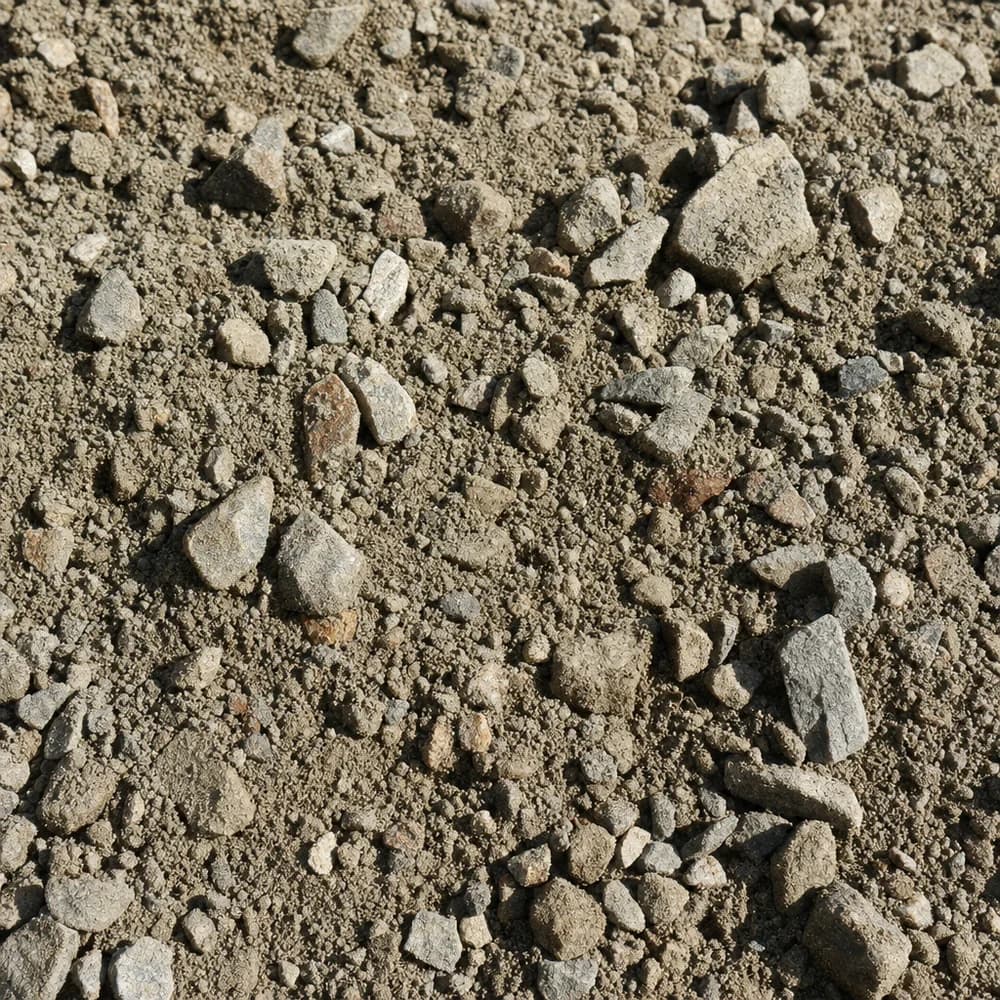
Crusher Run Calculator for Compacted Lanes and Pads
Enter your project dimensions
In most of California the base season is the dry half of the year. Ground a plate compactor can genuinely tighten shows up around late spring and stays workable into fall, and the first atmospheric river of winter is what closes it again. That timing matters before you touch this crusher run calculator, because the figure it wants is a compacted depth, and compacted depth is something you only get on ground that is damp rather than saturated.
What the ground under a lane does to the depth you enter
Clay in the Coast Range valleys and the Southern California basins. Expansive clay swells through the wet months and shrinks and cracks through the dry ones. A thin scatter of rock rides that movement and breaks up. Take the upper end of whatever range fits the job, and shape the surface so storm water runs off rather than standing on it.
Hardpan under parts of the Central Valley. A cemented layer a few feet down stops water moving deeper, so a lane on flat valley ground can stay wet underneath long after a storm passes. Depth alone does not solve that. The lane needs a fall across it and somewhere for the water to go.
Sandy coast and desert fans. Sand takes water quickly and gives loose footing, which is exactly what a compacted layer with fines is for. In the deserts, keep a lane or pad out of a wash, because a short intense burst of rain moves everything in the flow path.
Foothill slopes. Soil is often shallow over rock, so winter rain runs rather than soaks. A drive cut across a slope wants a crown or a cross-fall, not simply a thicker layer.
Mountain towns. At elevation in the Sierra Nevada and the northern ranges, freeze-thaw is a genuine design factor and frost depth runs 18 to 24 inches in towns such as Truckee and Big Bear Lake. The local building department sets that figure, so settle it with them before you fix a thickness.
Feeding a lane, a pad and a turnaround into the crusher run calculator
Start with the shape. Rectangle takes a length and a width in feet, which covers a lane or a pad footprint. Circle takes a diameter, which is how a round water-tank pad goes in. Multiple areas totals up to five pieces in one pass, so a lane, the turnaround at its head and a shed pad off to one side can all be measured on the same afternoon and added together.
Depth is entered in inches and accepts anything from 0.25 to 24. Enter the thickness you want after rolling, not the loose spread. Pick the material, leave the option that adds 10 percent for compaction and spillage ticked or untick it, and the results come back as cubic yards, tons and cubic feet at once. There is also a button that emails the figures to you, which is worth using if you are pricing two depths against each other.
Why 9.7 yards of crushed base arrives as more than 14 tons
The volume sum is plain arithmetic. Length in feet times width in feet times depth in inches divided by 12 gives cubic feet, and 27 cubic feet make a cubic yard. Weight is where the material matters. Crusher run and Class 2 base are both published here at roughly 3,000 lb per cubic yard, or 1.50 tons, and that is heavier than clean washed stone at about 2,800 lb because the fines sit in the voids between the larger pieces instead of leaving them open.
So a lane that comes out at 9.7 cubic yards is over 14 tons on the ticket. Nine yards of shredded mulch, by contrast, would be under three tons. Same cube, different load, which is why the tool converts using the weight of the material you selected rather than a single average.
Depths for a ranch lane, a shed pad and a paver course
The three sums below are illustrations rather than jobs anyone has ordered.
A 70 by 9 foot lane at five inches
Six hundred and thirty square feet at 5 inches compacted: 630 x 5 / 12 = 262.5 cubic feet, which is 262.5 / 27 = 9.72 cubic yards. At 1.50 tons per yard that is 14.6 tons, and 16.1 tons with the 10 percent option ticked. Build it in two lifts rather than one pass. Two compacted two-and-a-half-inch layers hold a grade for years longer than a single five-inch dump, and a light mist on each lift before the compactor goes over it tightens the material noticeably.
An 11 by 15 foot shed pad
One hundred and sixty-five square feet at 4 inches: 165 x 4 / 12 = 55 cubic feet, or 2.04 cubic yards, which is 3.06 tons. The 10 percent option brings it to 3.37. On soft or organic ground, strip the surface first and take the pad to 6 inches instead of adding depth on top of soil that will keep moving.
A paver course under a 10 by 12 seating area
Four inches compacted over 120 square feet: 120 x 4 / 12 = 40 cubic feet, or 1.48 cubic yards and 2.22 tons. Bear in mind that a paver base is measured past the edge of the paving itself, so use the paver base tool once you have a layout and let this page handle open pads and lanes.
The wheelbarrow load that fills the first rut of winter
The 10 percent option covers spillage and the tightening you get under a roller. Anything beyond that is better added at the tape, by rounding each measurement up to the next foot, particularly on an uneven subgrade where the real requirement can drift ten to fifteen percent either way. Crusher run is one of the few materials worth having a little left over, since a wheelbarrow load in the corner of the yard is what fills the first rut that appears after a wet week.
One thing not to do with it: keep it out of a French drain. The fines that make it compact are the same fines that hold water, so drainage trenches want clean drain rock with nothing in the voids. The travel layer is a separate job again, and surfacing a lane once the base is in is sized on its own tool at its own weight.
Crusher Run or Class 2 Base on the order line
California plans, yards and delivery tickets usually say Class 2 base, and some say crush and run or 2 inch minus for the same family of crushed stone with fines. The published weight here is the same 1.50 tons per yard either way, so the tonnage on your estimate does not change. If your plan names the Caltrans grade, size it on the Class 2 base tool and order Class 2 Base; if the ticket says crusher run, order Crusher Run and use the figures from this page. Quantity and date are chosen on the product page, and delivery is set by ZIP at checkout, so have a firm spot picked that the truck can back to; how bulk loads are booked covers what the driver needs at the far end.
Common questions
The plan says four inches of compacted base. Is four what goes in the depth box?
Yes. Enter the finished rolled thickness and leave the 10 percent option ticked, rather than guessing at a deeper loose figure. Placing it in two lifts is what gets you there.
The estimate shows yards and tons together. Which one do I order by?
Tons. Crusher run and Class 2 base are sold by weight here, so the tonnage is the order figure. The cubic yards are there to help you picture the pile and to compare the layer against a soil or mulch quantity on the same job.
Does the Circle option want the width of the water-tank pad across, or the distance out from the middle?
Switch to Circle and enter the diameter across the widest point in feet. A 12 foot circle is 113 square feet, so at 4 inches that is 37.7 cubic feet, 1.40 cubic yards and 2.10 tons. A tree ring goes in the same way.
What is the hand sum that turns square feet of Class 2 base into tons?
Multiply the area in square feet by the depth in inches, divide by 12, divide by 27, then multiply by 1.5. If your own figure and the tool's differ by more than a rounding step, one of the measurements went in wrong.
Does the 3,000 lb per yard figure still hold if I switch the material select to rounded stone?
No. Weight follows the material, not the depth. Crusher run runs about 3,000 lb per cubic yard and rounded 3/8 inch stone about 2,800 lb, so the volume matches and the tonnage does not. The same holds against river cobble at roughly 2,700 lb.
Related calculators
Base tonnage sorted? Good.
Crusher run by the ton, the cheapest structure on the yard, delivered free.