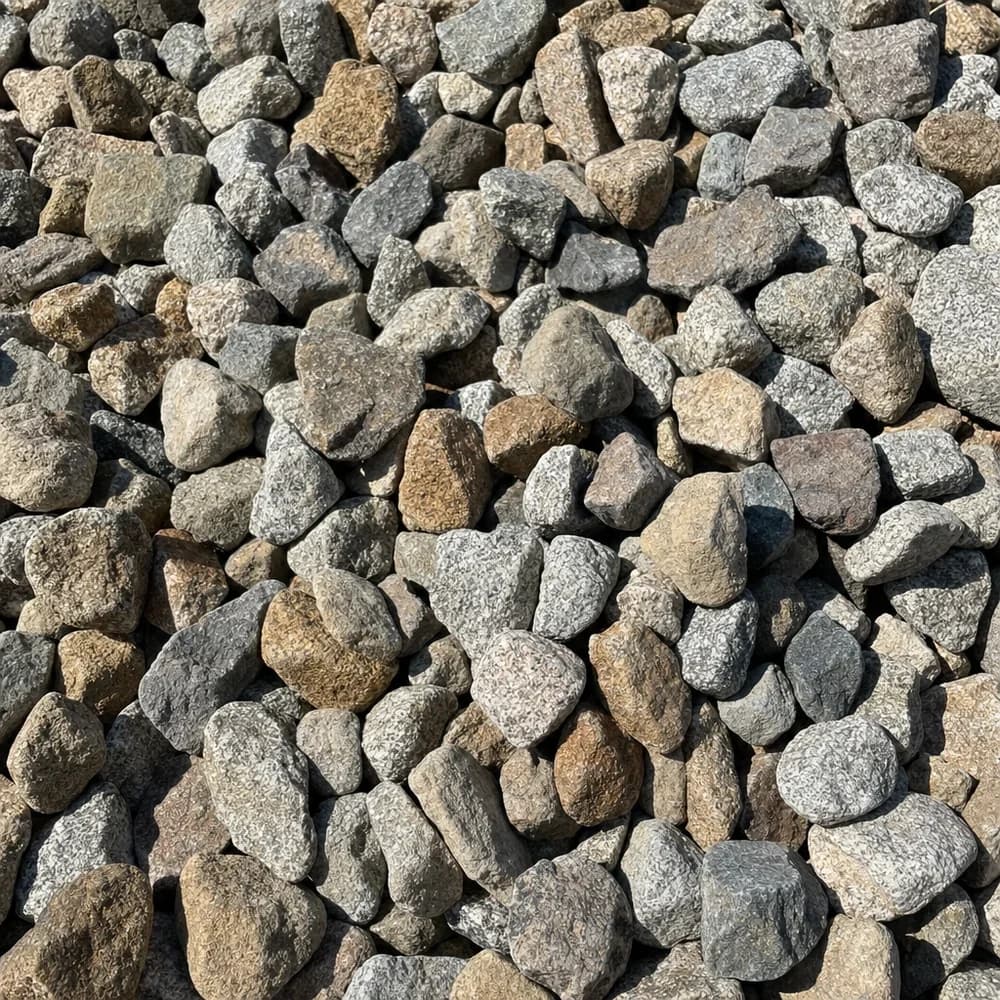
River Rock Calculator for Dry Creek Beds and Borders
Enter your project dimensions
A dry creek bed here sits idle for eight months and then earns its place in one February afternoon. That is what most rounded cobble is bought for, and it is also where two materials get mixed up. Cobble is the visible layer: it slows runoff, disguises the line of a swale and keeps bare soil from traveling. The stone that carries water through the ground is clean angular drain rock, buried in a trench and wrapped in fabric. This river rock calculator sizes the layer you can see. If the water has to move through the stone rather than across it, sizing the stone in a drainage trench is a separate job.
Walking the line the water already takes
Before the tape comes out, watch where the roof, the drive and the slope above send water during a real storm. Rain across most of the state arrives in a handful of large events, so the route is obvious for an hour and then forgotten until the next front. Set the bed on that route rather than where it looks neat on a plan. Widen it through the bends, where water leans on the outside of a turn, and keep the narrow sections for the straight runs. Width moves the order far more than length does, which makes this the stage where the tonnage is really decided.
Measuring a winding bed as three straight pieces
A curving creek line is measured as a short series of straight pieces. Take the length along the center of each run and an average width, ignoring the small lobes at the edges, then enter the pieces in Multiple areas, which accepts up to five. One depth applies to everything in a single run of the tool, so a two-inch border and a four-inch creek line are two calculations rather than five areas in one.
Two inches along a border, four down the creek line
Depth follows the stone, at roughly twice its diameter. Three-quarter to one inch cobble wants about two inches. One to three inch material wants three to four. Large cobble of two to four inches wants four to five, and the largest accent pieces are set individually rather than spread. If fabric still shows through after spreading, the layer is thin rather than the load short, which is the most common reason a second order gets placed a week later.
Entering a bed, a strip and two basins in the river rock calculator
Rectangle asks for length and width in feet. Circle asks for a diameter, which is how a downspout basin or a planting ring goes in. Multiple areas totals up to five pieces in one pass. Depth is entered in inches, anywhere from 0.25 to 24. Pick the material so the weight matches the stone you chose, decide whether to leave the option that adds 5 percent for compaction and spillage ticked, and the answer returns as cubic yards, tons and cubic feet together. The quote button sends the same figures to you by email, which is useful when the cobble and the drain rock below it are ordered as two lines.
A creek line, a foundation strip and two downspout basins
Three illustrations of the arithmetic, none of them a real order.
A 28-foot creek line
Twenty-eight feet long by an average 3.5 feet wide is 98 square feet. At 4 inches of one to three inch cobble: 98 x 4 / 12 = 32.7 cubic feet, which is 32.7 / 27 = 1.21 cubic yards, or 1.63 tons at 1.35 tons a yard. With the 5 percent option that becomes 1.27 yards and 1.71 tons.
A strip along the front of the house
Thirty feet by 2 feet is 60 square feet. At 2 inches of three-quarter to one inch cobble: 60 x 2 / 12 = 10 cubic feet, or 0.37 cubic yards and 0.50 tons. Grade the surface of the strip so it falls gently away from the wall.
Two basins under the downspouts
Each basin is a 4-foot circle, so 12.6 square feet, and the pair is 25.2 square feet. At 4 inches: 25.2 x 4 / 12 = 8.4 cubic feet, which is 0.31 cubic yards and 0.42 tons.
The three pieces together come to 1.89 cubic yards and about 2.55 tons, which is one small load rather than three errands.
Fabric down, anchor stones a third buried
Pin non-woven fabric before any stone goes on, because bare soil swallows cobble from below and weeds come up between it. Where the bed doubles as an active drainage route, wrap the fabric around the stone instead of laying it flat underneath. Set the largest anchor stones about a third of their height into the ground so they read as water-placed rather than tipped, and mix one to two inch material with occasional larger pieces so the bed does not look like a median strip. Hose the stone down once it is spread; haul dust dulls the color until it is rinsed off. Clear leaves later with a blower on a low setting rather than a rake, which flicks stone into the grass.
A ton of cobble is about three quarters of a yard
Cobble is published on this site at about 2,700 lb per cubic yard, which is 1.35 tons a yard. The cubic yard figure describes the space the bed will swallow; the ton figure describes what comes off the truck. Because a ton is only about three quarters of a yard, a delivered pile can look smaller than the bed it is meant to fill, and the cubic feet reading is the one to check against a wheelbarrow count when the job is small.
Cobble, large cobble or drain rock on the order line
Once the figures are settled, River Cobble covers most decorative beds and creek lines, Large River Rock supplies the anchor stones, and Drain Rock is the clean stone for the trench underneath. Delivery is arranged at checkout by ZIP code, and how a bulk load is scheduled covers access and the firm spot the truck can tip on.
Common questions
How close will this number be to what the bed actually swallows?
Close, if the width and depth you entered match what gets built. The arithmetic is exact; the uncertainty is in an average width taken across a curving bed and in ground that is not flat. Rounding each measurement up to the next foot covers more error than any percentage option does.
I have the tonnage. Which page do I buy from?
One to three inch material is sold as River Cobble, the two to four inch stone as Large River Rock, and the clean angular stone for a drainage trench as Drain Rock. Each product page is where you choose a quantity and a date.
Where should two or three tons of cobble be tipped?
On a firm, flat spot the truck can reach in reverse, clear of low branches and away from soft lawn, and as close to the bed as access allows. Cobble does not shovel; it is wheelbarrowed or raked, so the distance from pile to bed decides how long the day takes.
The estimate gives cubic yards and tons. What is each figure for?
Yards measure the space the stone has to fill and tons measure the weight arriving. Cobble is ordered by the ton here, so that is the figure to work to, with the yardage useful for comparing against anything quoted per yard.
Cobble never really compacts. Do I enter a loose depth or a settled one?
Enter the finished depth you want to see in the bed once it is raked level. Rounded stone settles very little, so the 5 percent option is mostly covering spillage and the thin front edge rather than compaction.
Related calculators
Rock beds are a one-time buy.
River rock, large river rock and drain rock by the ton, free delivery included.