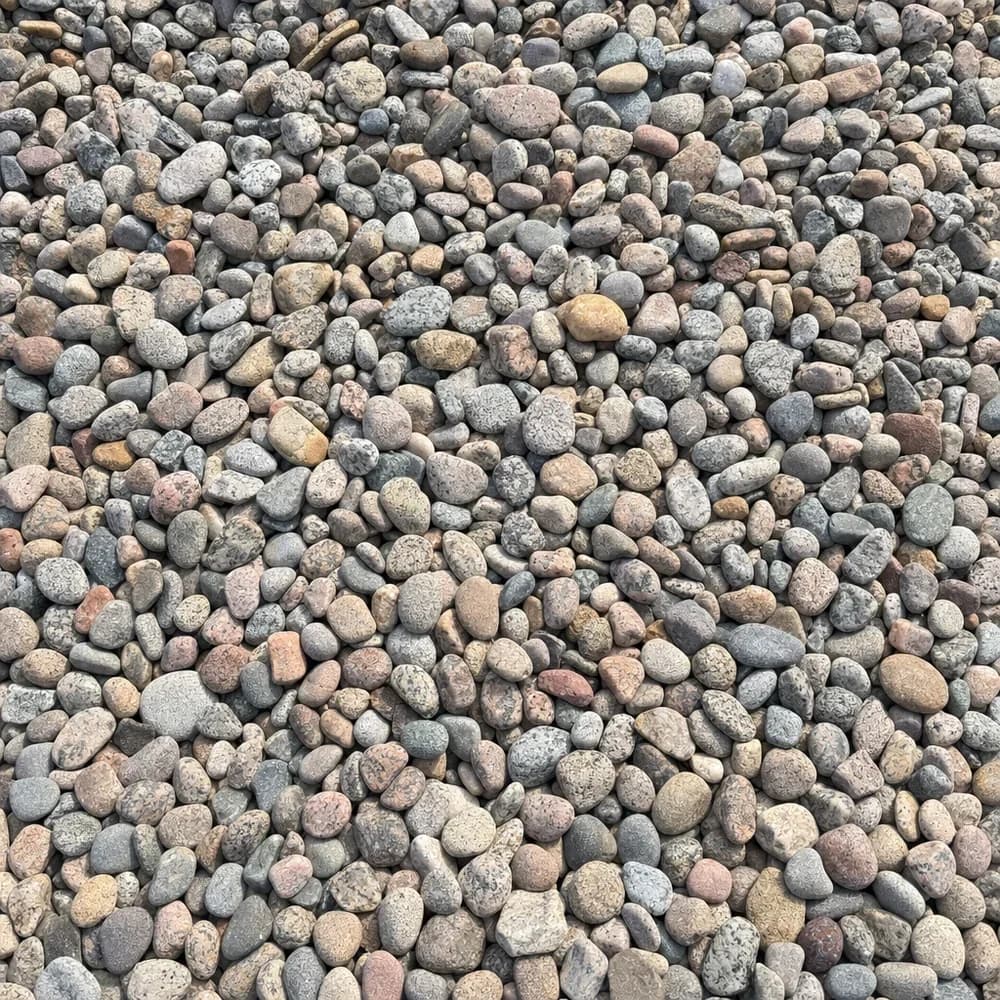
Pea Gravel Calculator for Seating Areas, Runs and Play Zones
Enter your project dimensions
The job that brings most people to a pea gravel calculator is a patch of lawn that has stopped earning its water. Once the grass is off, a seating circle, a dog run or a path in rounded 3/8 inch stone is a weekend rather than a project, and the work fits the long dry stretch from late spring into fall when the ground is firm and nothing is going to wash before it is edged. That timing also means the surface has months to settle in before the first real storm tests it.
A round fire-pit surround and a dog run measured the same afternoon
Gravel areas come in shapes that a tape handles badly, so measure them as the pieces they actually are. A seating circle is a diameter across the widest point. A run along a fence is a straight rectangle. A path that curves gets squared off to the rectangle that contains it, which over-measures slightly and is the right way to be wrong.
Bring all the pieces back to one list before you start entering anything. Pea gravel orders are small enough that two separate deliveries for one yard each is a poor use of a truck.
Entering the surround, the path and the run in one pass
Circle takes a diameter in feet, Rectangle takes a length and a width, and Multiple areas totals up to five pieces, so the surround, the path leading to it and the run behind the garage go in together.
Depth is entered in inches, from 0.25 to 24. Choose the material, decide on the option that adds 5 percent for compaction and spillage, and the result comes back as cubic yards, tons and cubic feet at once, with an email button that sends it to you in writing.
Why 3/8 inch stone still lands at 1.40 tons to the yard
Pea gravel is published here at about 2,800 lb per cubic yard, which is 1.40 tons. That is the same figure as crushed gravel and #57 stone, which surprises people who expect rounded stone to be lighter: the pieces are smaller and pack closer, so the voids between them are no larger.
Volume is area in square feet times depth in inches, divided by 12, divided by 27. Tons are yards times 1.4.
| Depth | 1 cubic yard covers | 1 ton covers |
|---|---|---|
| 2 inches | 162 sq ft | about 116 sq ft |
| 3 inches | 108 sq ft | about 77 sq ft |
| 4 inches | 81 sq ft | about 58 sq ft |
| 12 inches, play area | 27 sq ft | about 19 sq ft |
The walking band, and the fall zone that ignores it
Walking surfaces want 2 to 3 inches. Under 2 and the base shows through where feet land; over 3 and it starts to behave like dry sand underfoot. That narrow band covers seating areas, paths, fire-pit surrounds and dog runs.
Play areas ignore it entirely. A fall zone holds 9 to 12 inches of loose material, and the equipment manual sets the figure. At 12 inches a ton reaches only about 19 square feet, so a play area is the one pea gravel job that arrives as a real load. Note what is being ordered, though: this is landscape pea gravel, it is not sold as certified playground surfacing, and the depth, the fall-zone footprint and the maintained depth all come from the equipment manufacturer's instructions rather than from this page.
Three worked sums
Illustrations, not orders anyone has placed.
A 15 foot fire-pit surround at 3 inches. A 15 foot circle is 176.7 square feet. 176.7 x 3 / 12 = 44.2 cubic feet, which is 44.2 / 27 = 1.64 cubic yards, or 2.29 tons. With the 5 percent option, 2.41. Lay 2 inches of compacted Decomposed Granite underneath first so chair legs have something to stand on.
A 24 by 7 foot dog run at 3 inches. 168 square feet: 168 x 3 / 12 = 42 cubic feet, which is 1.56 cubic yards and 2.18 tons. Rounded stone is easier on paws than angular crushed rock and rinses clean.
A 16 by 16 foot fall zone at 10 inches. 256 square feet: 256 x 10 / 12 = 213.3 cubic feet, which is 7.90 cubic yards and 11.06 tons. About one and a half times the area of the surround above, and nearly five times the stone.
Edging set proud, and what a five percent slope does
Rounded stone moves. That is its whole character, and it is why the border matters more than the depth. Set steel, aluminum, timber or paver edging an inch above the finished gravel line so the stone has something to stop against. Edging laid flush with the surface lets the top layer walk out over a season.
Past about a five percent grade, edging alone stops being enough, because winter runoff and foot traffic both push stone downhill faster than a border can hold it. Two options: a honeycomb stabilization grid under the gravel, or angular walkway gravel instead, which interlocks and stays put on a slope. On a long path that starts level and climbs, using both materials by grade is a perfectly reasonable answer.
Topping the worn line to the gate every couple of seasons
Order to the next round figure rather than the exact decimal. Every gravel surface develops a worn line where people actually walk, and topping that up with a bucket every couple of seasons, plus a rake over the whole surface twice a year, is the entire maintenance schedule.
Delivery is arranged by ZIP at checkout, and what the truck needs to reach is a clear route to a firm drop point. Put the pile at the far end of the area and work back toward it as you spread, because moving pea gravel twice is a job nobody enjoys once.
Running one set of dimensions through three decorative tools
The three decorative options are not interchangeable, and running the same dimensions through each tool is a quick way to see it. Pea gravel is the comfortable one underfoot and the one that migrates. Angular walkway gravel grips and holds a grade but is harder on bare feet, and it is sized on the gravel tool. River cobble is larger and ornamental, better in a bed or a dry creek than under chairs, and sized on the river rock tool at a different published weight. The volumes will match across all three; the tonnage will not. When the figure is settled, choose an amount and a date on the Pea Gravel page, and the rest of the material tools covers the base and soil quantities on the same job.
Common questions
Where should a pea gravel load be tipped for a back-garden seating area?
On a firm, flat spot with clear truck access, as close to the area as the route allows, with a tarp down if it is landing on paving. Round stone rolls, so a pile on a slope spreads itself in a direction you did not choose.
The result gives yards and tons. Which is the ordering figure?
Tons. Pea gravel is sold by weight here. The cubic yards are useful for picturing the pile and for comparing this layer against a soil or mulch quantity elsewhere on the same job.
Pea gravel does not really compact. What depth do I enter?
The finished loose depth you want to see, which for a walking surface is 2 to 3 inches. Unlike a base course there is no rolled thickness to allow for, so the 5 percent option here is covering spillage and the raking-out rather than compaction.
How do I size a circular surround around a fire pit?
Enter the outer diameter in feet using the circle shape, then subtract the pit itself by eye if it is large. A 10 foot circle is 78.5 square feet, so at 3 inches that is 19.6 cubic feet, 0.73 cubic yards and 1.02 tons.
Can I check the tonnage myself?
Area in square feet times depth in inches, divided by 12, divided by 27, times 1.4. A 100 square foot path at 2 inches gives 16.7 cubic feet, which is 0.62 cubic yards and 0.87 tons.
Related calculators
Under two tons covers most patios.
3/8 inch natural pea gravel, priced by the ton, delivered free.