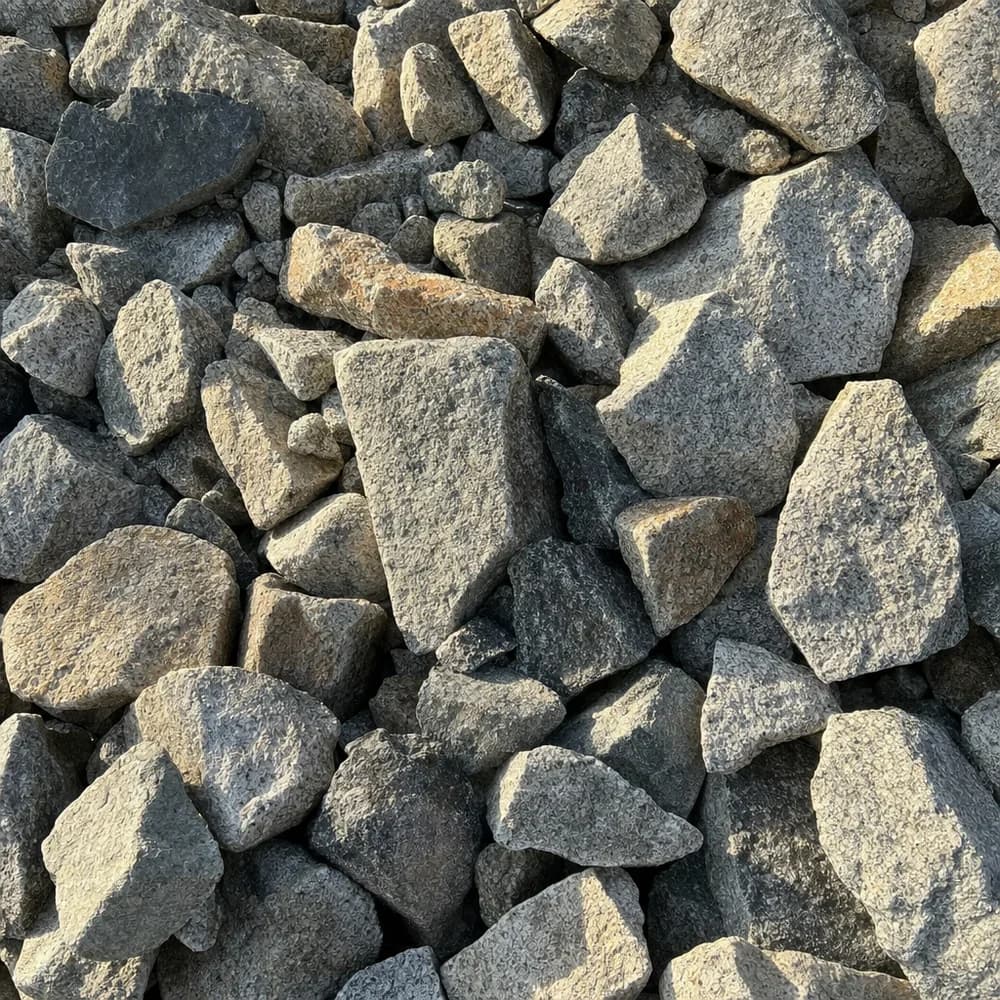
Rip Rap Calculator for Banks, Slopes and Culvert Outlets
Enter your project dimensions
Almost every order this rip rap calculator has to correct comes from one of two habits. The first is entering a landscape depth. Three inches is a bed of decorative stone; armor stone goes down at 12 inches and often 18 or 24, so a bank ordered at gravel depth arrives as roughly a sixth of what the slope needs. The second is measuring the ground plan instead of the bank. A creek bank drawn on paper is a line; the face you are actually covering leans back from it and is longer than the line suggests.
Both errors run the same direction, which is why a riprap delivery so often looks small until somebody starts spreading it.
Measuring down the bank face, not across the map
Run the tape down the slope itself, from the toe to wherever the armor is going to stop, and use that as one dimension. The other is the length of shoreline, channel or bank being protected. Multiply the two and you have the slope-face area, which is the only area figure worth entering.
Prepare the bank to 2:1 or flatter before any rock goes on it. A steeper face is an engineering question rather than a question of buying more stone, and no layer thickness fixes a slope that wants to fail. If you are unsure which of those you are looking at, describe the slope to us before ordering.
Giving the rip rap calculator a slope face and a layer thickness
Rectangle takes the slope-face length and the run in feet. Circle takes a diameter, which suits a scour pool or a round outlet apron. Multiple areas totals up to five pieces, which is what a bank that turns a corner at a culvert needs.
Depth goes in as inches and the box accepts up to 24, which is also the practical top of the residential range. Choose the material, decide on the option that adds 5 percent for compaction and spillage, and the answer comes back as cubic yards, tons and cubic feet, with an email button that puts the figures in writing before you commit to a load this size.
Set the layer at 1.5 to 2 times the largest stone dimension, with 12 inches as the floor for anything meant to resist erosion.
3,100 lb a yard, and the ton that covers 17 square feet
Riprap is published here at about 3,100 lb per cubic yard, or 1.55 tons, which is the heaviest figure on this site. Volume is slope-face area times thickness in inches, divided by 12, divided by 27. Tons are yards times 1.55.
| Layer thickness | 1 ton covers | Tons per 100 sq ft |
|---|---|---|
| 12 inches | about 17 sq ft | 5.7 |
| 18 inches | about 12 sq ft | 8.6 |
| 24 inches | about 9 sq ft | 11.5 |
Set that against 3 inches of decorative cobble, where a ton reaches about 80 square feet, and the gap stops being abstract. Spread two inches deep as a landscape layer, a ton of stone covers well over a hundred square feet; the same ton laid as armor at 12 inches covers a square roughly four feet on a side.
Four to eight inch stone for a creek bank, larger for fast water
Size the stone to the force of the water, not to the look of the bank. Four to eight inch stone handles creek banks, downspout outfalls and low-flow channels. Eight to twelve inch suits faster channels and edges taking boat wake. Where a plan for a highway, a spillway or a public drainage structure specifies its own size class and depth, follow the drawing rather than any general guidance.
If you are between two sizes, take the larger stone and the thicker layer. Weight is what resists movement, and the cost of being wrong is placing the same rock twice.
Two things go under the armor. Either non-woven geotextile, sourced from a landscape supplier since it is not stocked here, or 3 to 4 inches of #4 Crushed Stone as a bedding course, published here at about 2,900 lb per cubic yard, or 1.45 tons. Rock set straight onto bare soil settles once water starts taking the bank out from underneath it. Start at the bottom: the lowest course goes in below the waterline or below the expected scour depth, because riprap unravels from its toe upward and not from the top down.
Before that lowest course goes in below the ordinary high water line of a creek, pond or shoreline, find out what approval your state and local authorities require. Placing rock in and along a watercourse is commonly permitted work, what is required varies with the waterbody, and this page is not a substitute for asking.
A culvert outlet on a foothill drive and a burned slope above a creek
These are illustrations rather than jobs anyone has ordered.
Forty feet of creek bank with a 7 foot face. Slope-face area is 280 square feet. At 18 inches: 280 x 18 / 12 = 420 cubic feet, which is 420 / 27 = 15.56 cubic yards, or 24.1 tons at 1.55. With the 5 percent option, 25.3 tons. The bedding layer under it, at 4 inches of #4 stone over the same 280 square feet, is 93.3 cubic feet, or 3.46 cubic yards and 5.0 tons.
An apron below an 18 inch culvert under a foothill drive. Carry the apron 4 to 6 pipe diameters downstream, so 6 to 9 feet, because that is where the flow scours. An 8 by 6 foot apron is 48 square feet: at 12 inches that is 48 cubic feet, or 1.78 cubic yards and 2.76 tons. Small in tonnage, and the piece of a foothill drive most likely to fail in a wet winter.
Timing matters as much as sizing in California. The ground that needs armoring is usually ground that was burned in a recent fire season or scoured in the last set of storms, and the work window is the dry months before the next atmospheric river arrives. Placed rock on a slope appears on many local plans as rock slope protection, which is the Caltrans term for the same thing.
The stone you keep back for the first inspection after a storm
Order a little over rather than exactly. When the water drops after the first big storm, walk the bank and look at three things: the toe, for rock that has shifted; the face, for soil showing between stones or fabric visible through a gap; and the outfall apron, for scour starting below it. Ten minutes twice a year is the whole regime, and a small reserve pile on site is what turns a finding into a repair the same afternoon.
Riprap is ordered by the ton on the RipRap page, with quantity and date chosen there and delivery set by ZIP at checkout. Check the access for a heavy load before you order rather than after: a loaded truck bogging in the last twenty feet of a soft bank means the stone gets handled twice. For a dry creek bed that is decorative rather than structural, size it on the river rock tool and use Large River Rock instead. That is cobble, meant to slow and look like water, not to stand against it.
Common questions
The bank turns a corner at a culvert. How do I enter an L-shaped run?
Use Multiple areas and split it at the corner into two straight runs that do not overlap, entering each with its own slope-face length and the same layer thickness. The tool totals them, and it takes up to five pieces.
Should the toe trench and the apron beyond the armored face be included in the area?
Yes for both. The toe course and the outfall apron are part of the same system and they take stone at the same thickness. What you leave out is any ground beyond where the rock actually stops.
How do I split the order between the bedding course and the armor on top?
Run the same slope-face area twice. Once at 3 to 4 inches with the bedding stone selected, and once at your armor thickness with riprap. The layers have different published weights, so the tonnages are not proportional to the depths.
The bank is curved rather than straight. How should I measure it?
Break the curve into two or three straight segments that follow it closely, measure each one, and enter them as separate areas. Squaring off slightly over-measures, which on an armor job is the side to be wrong on.
A stretch of existing riprap lost stone in the last storm. How do I size the top-up?
Measure only the sparse patches rather than the whole bank, and treat each as its own small area at the full layer thickness. Refilling a thin patch to half depth leaves the same weak point that opened in the first place.
Related calculators
Banks don't armor themselves.
RipRap by the ton with free delivery, plus the #4 bedding stone to go under it.