Dirt Calculator for Low Spots, Trenches and Raised Grade
Enter your project dimensions
Most people arrive at a dirt calculator because of something they watched happen in January: a corner of the lawn that held water for three days, a strip beside the foundation that sank, a trench line that settled into a visible scar after the first storms. The fix belongs to the other half of the year. Fill goes in properly once the ground has dried out, because saturated clay smears under a tamper instead of compacting, and a wheelbarrow through wet valley soil is its own argument for waiting.
Reading the deep end and the shallow edge of a dip
A hole is easy. Length, width and depth in feet, and the sum is done. The awkward case, and the common one, is a shallow depression with no consistent depth at all. Measure the deepest point and the shallowest edge, then use the midpoint of the two as your average depth. A dip that is 7 inches down at the center and an inch at the rim is a 4 inch job, not a 7 inch one, and treating it as 7 inches buys you nearly twice what the ground will take.
For a trench, take the run in feet, the width in feet and the depth in inches. For a berm, measure the footprint it will sit on and enter about half the height at the crown, because a berm is a triangle in cross section rather than a box and half the peak is the average depth across the footprint.
Putting an uneven low spot through the dirt calculator
Rectangle asks for length and width in feet. Circle asks for a diameter, which suits a filled-in pond, an old stump hole or a planting basin. Multiple areas adds up to five separate pieces, so a lawn dip, a strip along the foundation and a short trench can be entered as three entries and totaled in one result.
Depth goes in as inches, anywhere between 0.25 and 24. Choose the material, leave the option that adds 10 percent for compaction and spillage ticked or untick it, and the answer comes back as cubic yards, tons and cubic feet together. The email button sends the figures to you in writing, which is handy when the fill and the topsoil above it are being ordered as two separate layers.
Rain adds weight to the pile, not volume to the hole
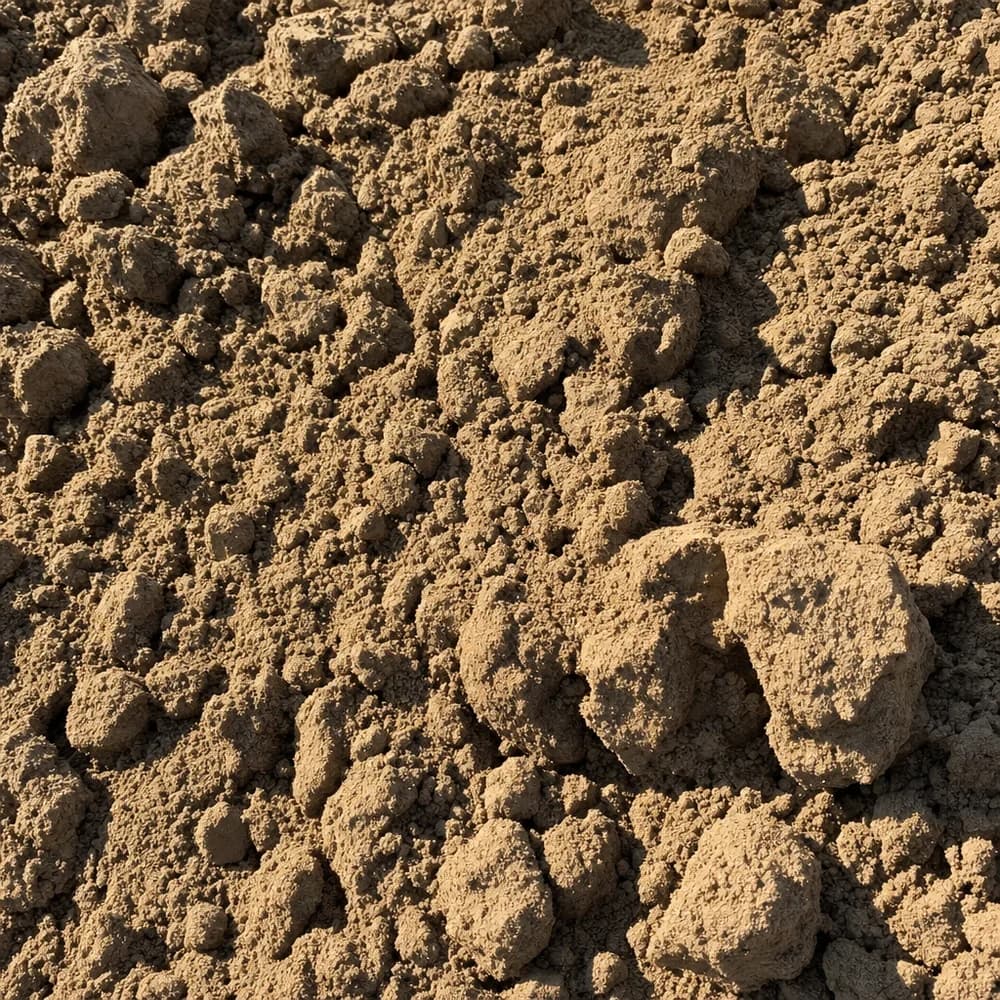
Fill dirt is published here at about 2,400 lb per cubic yard, or 1.20 tons. Screened topsoil is lighter at roughly 2,200 lb, or 1.10 tons, because it carries organic matter rather than packed mineral subsoil. A cubic yard of fill that has sat uncovered through a storm can reach 3,000 lb, or 1.50 tons.
That last figure changes nothing about how much you order. Rain adds weight, not volume, and the hole is still the same size. It changes what the load is like to move, which is why a tarp over the pile before a front comes through is worth the five minutes.
| Material | Weight per cubic yard | Tons per yard |
|---|---|---|
| Fill dirt, dry | about 2,400 lb | 1.20 |
| Fill dirt, wet | up to 3,000 lb | 1.50 |
| Screened topsoil, for comparison | about 2,200 lb | 1.10 |
A ponding lawn, a utility trench and a berm on valley clay
Three worked illustrations, none of them a real order.
A 16 by 13 foot dip that held water
Two hundred and eight square feet, 7 inches at the low point and 1 inch at the rim, so 4 inches average: 208 x 4 / 12 = 69.33 cubic feet, which is 69.33 / 27 = 2.57 cubic yards, or 3.08 tons dry. With the 10 percent option that is 2.83 cubic yards. On clay or over hardpan, filling a dip without giving the water a route out simply moves the puddle, so work out where the surface will drain to before the load arrives.
A 40 foot utility trench
Two feet wide and 16 inches deep: 40 x 2 = 80 square feet, then 80 x 16 / 12 = 106.7 cubic feet, which is 3.95 cubic yards and 4.74 tons. Backfill in 6 to 8 inch layers and compact each one. A trench that is filled in a single dump will show its line across the lawn by the end of the next wet season.
A 26 by 4 foot berm
Standing 20 inches at the crown, so 10 inches average across the footprint: 104 x 10 / 12 = 86.67 cubic feet, which is 3.21 cubic yards and 3.85 tons. A berm built to screen a road or steer runoff wants the same layered compaction as a trench, and then a growing layer over the top if anything is going to be planted in it.
Building a lawn repair half an inch proud
Loose fill settles. The way to absorb that is not to inflate the depth you enter but to finish the surface slightly high and let it come down to level. Half an inch over a lawn patch is about right, and soaking each layer and letting it consolidate does the rest if you have no compactor.
Two things to keep out of the fill: organic debris and buried wood, which rot and leave a soft hollow years later, and any assumption that deep fill under a slab or a footing is a do-it-yourself measurement. That case calls for an engineer's compaction specification, thinner lifts and proper equipment.
Delivery is arranged by ZIP at checkout, so pick a firm, flat drop point the truck can reach without crossing soft ground, and keep it close to where the wheelbarrow run ends; how a bulk load is scheduled covers the rest, and the full set of material tools covers whatever else the job needs.
Fill dirt below, topsoil above: which tool sizes which layer
Fill dirt is the structural layer. It is mineral subsoil with the rock and debris taken out, low in organic content, and it holds a grade precisely because there is nothing in it to break down. Nothing grows well in it. Bring the fill to 4 to 6 inches below your finished level, then put Top Soil on top, and size that layer separately: the topsoil tool for lawn and bed prep over clay or sandy native ground, and the garden soil tool for raised beds and planting areas. Where the raised grade is going under something that carries weight, the stone over it is a third calculation again, on a pad that will carry weight. When the quantities are settled, choose an amount and a date on the Fill Dirt page.
Common questions
Where should a fill load be dropped for a job at the back of the property?
Somewhere firm and flat that the truck can reach without crossing a lawn or a septic run, and as close to the work as access allows. Fill dirt is heavy for its volume, so every extra wheelbarrow length counts. A pile placed high sheds most of the rain that falls on it.
The result gives cubic yards and tons. Which figure do I order by?
Yards. Fill dirt is sold by the cubic yard here, so that is the ordering number. The tonnage is there to tell you what you are about to move, which matters when the difference between a dry load and a rained-on one is 600 lb a yard.
Should the depth I enter be the loose depth or the finished one?
The finished grade you want after the fill has settled and been compacted. Leave the 10 percent option ticked, place in 6 to 8 inch lifts, and leave lawn repairs slightly proud rather than entering a deeper figure.
How do I size a round stump hole or an old planting basin?
Use Circle and enter the diameter in feet. A 5 foot circle is 19.6 square feet, so at 18 inches deep that is 29.4 cubic feet, or 1.09 cubic yards and about 1.3 tons.
Can I verify the figure without the tool?
Multiply the area in square feet by the average depth in inches, divide by 12 for cubic feet, then divide by 27 for cubic yards. Multiply those yards by 1.2 for dry tons. A 4 by 4 foot hole 3 feet deep is 48 cubic feet, so 1.78 cubic yards.
Related calculators
Cheap by the yard, free to your gate.
Screened fill dirt for grading and backfill, delivered across California.